
Bacteria constantly adjust their gene activity in response to changes in their environment. Nutrient availability, temperature, oxygen, stress, and other signals can alter which genes are expressed and how strongly they are activated. Understanding these regulatory responses is therefore central to explaining how bacterial cells adapt and survive.
Traditionally, studying bacterial gene regulation has relied heavily on experimental measurements of gene expression and regulatory interactions. Today, computational biology is adding a new layer: using large biological datasets and machine learning to predict how bacterial genes may respond to different conditions.
From DNA Sequences to Gene Regulation
Gene regulation begins with information encoded in DNA. Regulatory regions such as promoters contain sequence features that influence whether and when genes are transcribed.
In Escherichia coli, researchers are increasingly combining experimental measurements with computational models to understand how regulatory systems respond to different environments.
This type of work illustrates an important transition in bacterial research: instead of studying gene expression only after an experiment has been performed, computational models can begin to describe and predict how regulatory systems may respond to changing conditions.
one simple example of gene regualtion system in E.coli :
The maltose operon is an example of a positive control of transcription. When maltose is not present in E. coli, no transcription of the maltose genes will occur, and there is no maltose to bind to the maltose activator protein. This prevents the activator protein from binding to the activator binding site on the gene, which in turn prevents RNA polymerase from binding to the maltose promoter. No transcription takes place.

Machine Learning and Regulatory Networks
Machine Learning and Bacterial Regulatory Networks
Bacterial genes do not operate independently. They form transcriptional regulatory networks, in which transcription factors influence the expression of multiple genes.
Machine learning is increasingly being used to reconstruct these networks from genomic and gene-expression data. In 2025, researchers introduced PGBTR, a computational framework based on convolutional neural networks for inferring bacterial transcriptional regulatory relationships. The method was evaluated using E. coli and Bacillus subtilis datasets and showed improved performance compared with several existing approaches. 
The workflow of PGBTR. A Convert gene expression data (by microarray or RNA-seq) into PDGD (probability distribution and graph distance) matrices. B Divide the PDGD matrices into training and testing datasets. During the model training process, if a TF-gene pair is present in the transcriptional regulatory network, it is assigned a label of 1; otherwise, it is assigned a label of 0. C Obtain the predicted labels (0 or 1) of the TF-gene pairs. Based on these labels, TRN can be constructed. D The neural network structure of CNNBTR (convolutional neural networks for bacterial transcriptional regulation inference)
The importance of this approach goes beyond identifying individual regulatory interactions. Computational reconstruction of regulatory networks can help researchers understand how groups of genes work together and how changes in one part of a regulatory system may affect other biological processes.
Predicting How Bacteria Respond to Their Environment
One particularly interesting direction is the prediction of gene regulation under specific environmental conditions.
A study published in the Computational and Structural Biotechnology Journal developed DeepMGR, a deep-learning model designed to predict whether a gene in E. coli would be upregulated, downregulated, or unchanged under a particular cultivation condition. The model used information about the gene's DNA sequence together with environmental variables such as nutrients, aeration, and trace elements.
The model achieved an accuracy of 0.867 on its test dataset, demonstrating that machine learning can capture relationships between genetic information, environmental conditions, and transcriptional responses.
This creates an important computational possibility: researchers can begin asking not only what genes are expressed, but how gene expression might change when the bacterial environment changes.

Overall scheme of DeepMGR that predicts the direction of gene regulation in E. coli under a specific cultivation condition. (A) Inputs of DeepMGR include DNA sequence of a target gene, presence (‘1′) or absence (‘0′) of aeration and trace elements, and concentration and structural information (SMILES) of up to ten nutrients. DeepMGR accepts information on a single gene and one cultivation condition at a time. (B) All the input data first need to be represented (or featurized) as numerical vectors. A one-hot encoded DNA sequence vector has a length of 15,000 (= 5 ×3000) because each base requires five elements to represent ‘A′, ‘T′, ‘G′, ‘C′, or an empty space, and genes with up to 3000 base pairs were considered in this study. Presence or absence of aeration and trace elements are indicated as binary features. Real numbers are used for concentration of up to ten nutrients. For structural information, SMILES of up to ten nutrients are encoded as Morgan fingerprints with radius of 3 and bits of 64 and 1024. (C) Feedforward neural network receives the featurized input data through various nodes, and classifies whether the target gene is upregulated, downregulated, or not regulated under a cultivation condition. (D) Classification results from DeepMGR can be further analyzed in comparison with experimental data. read more here
AI for Understanding Bacterial DNA
Artificial intelligence can also be applied directly to bacterial DNA sequences.
A recent open-access study introduced DNABERT2-CAMP, a hybrid Transformer and convolutional neural network designed to recognize promoter sequences in E. coli. The model was trained using experimentally validated promoter sequences and non-promoter sequences and achieved a ROC-AUC of 97.28% during cross-validation. those sequences and connect them to biological functions.
Promoter recognition is important because promoters help determine where transcription begins. Being able to identify these regulatory sequences computationally can therefore support genome annotation and the design of synthetic biological systems Learn more here
From Prediction to Biological Design
The most forward-looking development is the move from predicting regulatory activity to designing regulatory DNA.
The open-access DeepCROSS study introduced a generative AI framework for the inverse design of bacterial 5′ regulatory sequences. The researchers constructed a representation from approximately 1.8 million regulatory sequences collected from thousands of bacterial genomes. They then combined computational prediction with experimental testing in E. coli and Pseudomonas aeruginosa to explore and optimize new regulatory sequences.
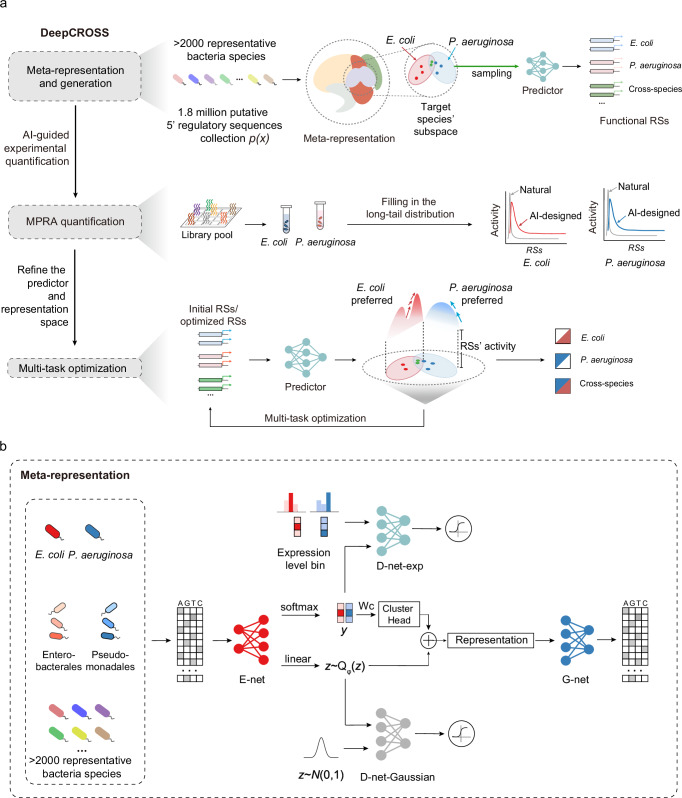
DeepCROSS uses thousands of natural 5′ regulatory sequences (RSs) collected from NCBI to learn how bacterial regulatory sequences control transcription. It then generates synthetic RSs, including sequences that can work across different bacterial species or are preferred by a specific species.
These synthetic sequences are tested in E. coli and P. aeruginosa using MPRA to measure their transcriptional activity. The best sequences are then optimized and experimentally validated.
The AAE model converts each DNA sequence into a 64-dimensional numerical representation, helping the AI identify and generate useful sequence patterns. The training data included sequences from E. coli, P. aeruginosa, related bacterial groups, and more than 2,000 bacterial species.
This represents a different way of thinking about bacterial genomics. Instead of moving only from:
DNA → Analysis → Biological interpretation
researchers can begin exploring:
Desired function → Computational design → DNA sequence → Experimental validation
The result is a transition from computational biology as an analytical tool toward computational biology as a design tool.
The Computational Future
The future of bacterial research is therefore not simply about generating more genomic data. It is about making that data interpretable, predictive, and usable for biological discovery.
As AI models become better at learning relationships between DNA sequences, gene regulation, cellular states, and environmental conditions, computational biology could increasingly help researchers explore bacterial behavior before conducting every experiment in the laboratory.
The emerging direction is clear:
Read bacterial genomes → understand regulatory systems → predict cellular responses → design biological functions.
This is where bacterial biology and computational science increasingly converge.